Track Your Wine Collection's Value Automatically
Madeleine Cruickshank
September 25, 2025 · 6 min read
How can I track my wine collection's value automatically?
Use a wine app with built-in valuation, like InVintory's Collection Analytics, which pulls current market pricing for your bottles from multiple data providers and updates your collection's total value continuously. This replaces manually researching individual bottle prices and updating a spreadsheet by hand.
Why Manual Valuation Falls Behind
Spreadsheets and notebooks can log what you own, but they can't tell you what it's worth right now. Wine prices shift with vintage reputation, critic scores, scarcity, and general market demand, and a number you researched six months ago may already be stale. Manually re-checking prices for a large collection is realistically something most collectors do rarely, if at all, which means the "value" most people quote for their own cellar is often a rough guess rather than a current figure.
This matters most in a few specific situations: getting insurance coverage right, understanding your collection before a sale, or simply knowing what you actually own in financial terms, not just in bottle count.
How Automated Valuation Actually Works
Automated tools pull current market pricing data from external providers and match it against your specific bottles, factoring in details like producer, vintage, and bottle size. Rather than a single static number, your collection's value updates as market prices shift and as you add or remove bottles.
InVintory's Collection Analytics tracks real-time value across your entire collection this way, sourced from multiple market data providers, so the number you see reflects current conditions rather than a snapshot from whenever you last happened to check.
What information does an app need to value a bottle accurately?
At minimum, an app needs the producer, vintage, and bottle size to match a wine to current market pricing. More complete records, including purchase price and provenance, make the resulting valuation more useful for insurance or resale purposes, even though they aren't strictly required for a basic price estimate.
Setting Up Your Collection for Accurate Tracking
Catalog every bottle with real detail
Producer, vintage, region, and bottle size are the minimum for an accurate valuation match. The more complete your records, the more reliable the resulting number.
Keep purchase records where you can
Purchase price and date aren't required for valuation, but they matter if you ever need to document a bottle's history for insurance or estate purposes.
Update your collection as it changes
A collection's total value is only as accurate as its current bottle count. Log new purchases and consumed bottles promptly rather than batching updates.
Review your collection's value regularly
Checking in often, rather than only when you're curious or need a number for a specific purpose, helps you catch meaningful shifts in your collection's value as they happen.
What This Looks Like Day to Day
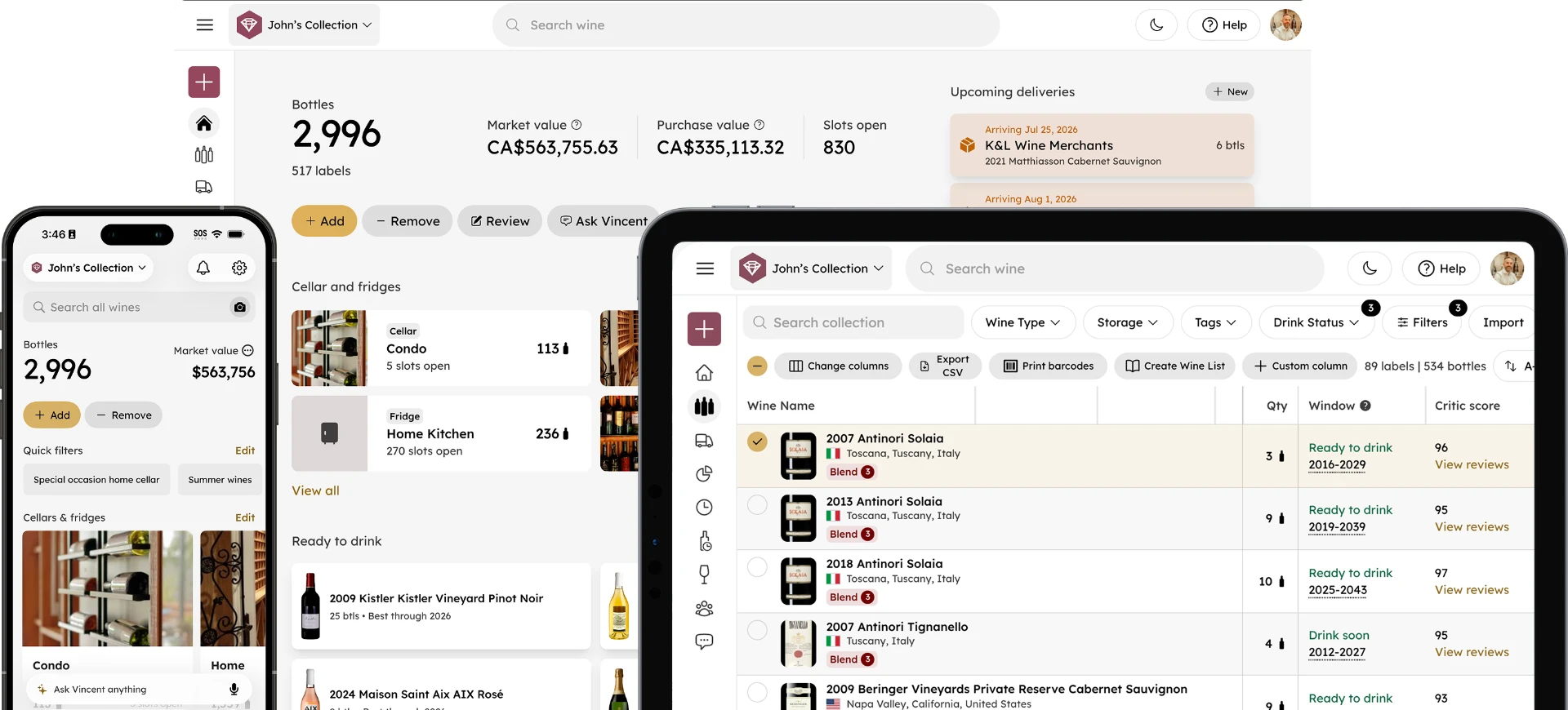
Once your collection is set up, checking your current value is a matter of opening the app rather than starting a research project. InVintory surfaces your total bottle count and market value directly on your home screen, updated automatically, alongside the rest of your collection data. For more on what else lives on that same screen, see our full home screen feature guide.
If you're deciding whether a specific bottle or category in your collection is likely to hold or grow in value in the first place, that's a related but separate question from tracking the value of what you already own. See our guide to which wines actually hold their value for that side of the equation.
Documentation That Makes Valuation More Than a Number
A current value figure is useful on its own, but it becomes far more useful when it's backed by documentation, especially for higher-value bottles where the difference between a rough estimate and a defensible valuation actually matters.
Purchase records
Where you bought a bottle, from whom, and at what price establishes a starting point that a generic market price alone doesn't provide. This matters most for auction purchases, allocated releases, or anything bought directly from a producer.
Storage history
A documented record of proper storage conditions, ideally continuous rather than reconstructed after the fact, supports a bottle's condition claim if you ever need to demonstrate it wasn't compromised by heat, light, or humidity swings.
Condition notes over time
For long-held bottles, periodic notes on fill level, label condition, or cork appearance build a history that's more convincing than a single inspection at the point of sale or claim.
Photos where practical
A photo of a bottle's label and fill level at the time of purchase, and again periodically for high-value bottles, adds a visual record that's hard to dispute later.
None of this is required to get a basic valuation from an app like InVintory, but for the bottles in your collection where value matters, whether for insurance, eventual resale, or simply peace of mind, this is the layer that turns a number into something you could actually stand behind if you needed to.
Do I need to document every bottle this thoroughly?
No. This level of documentation matters most for your higher-value or harder-to-replace bottles. For everyday drinking wine, basic cataloging (producer, vintage, size) is enough to keep an accurate valuation without adding unnecessary record-keeping to bottles you'll open within the year anyway.
Automated Valuation vs. Manual Research
The core tradeoff is time versus control. Manual research lets you cross-reference sources yourself, but it doesn't scale past a handful of bottles without becoming a real time commitment, and it goes stale the moment you stop checking. Automated valuation trades some of that manual control for a number that stays current without ongoing effort on your part, which matters more (and is more convenient) the larger your collection gets.
For collectors comparing platforms on this specific point, see our comparison of InVintory and CellarTracker, which covers valuation approach alongside other differences between the two.
Getting Started
If you're setting up a collection for the first time, start by organizing what you already own so every bottle has the details needed for an accurate valuation. From there, automated tracking does the ongoing work of keeping that number current.
Knowing what your collection is worth shouldn't require a research project every time you want the answer.
Want a real-time number instead of a guess?
Explore Collection Analytics in InVintory →
FAQ
Can automated apps give me an accurate, real-time collection value?
Yes, for bottles with good market data available. Widely traded wines tend to have more current, reliable pricing than rare or obscure bottles, which may rely on less frequent data points.
Is my collection data safe in a wine valuation app?
Reputable platforms use standard security practices to protect account and collection data. If data privacy is a concern, review a platform's specific privacy policy before entering detailed collection information.
Do I need a large collection for automated valuation to be worth using?
No. Automated valuation works the same way regardless of collection size; it simply saves more time relative to manual research as your collection grows.
What's the best way to set up my collection for accurate valuation?
Catalog each bottle with producer, vintage, region, and bottle size at minimum, and keep purchase records where possible for a more complete picture. See our guide to organizing a wine collection for a full walkthrough.
Ready to see your collection's real-time value?